september, 2026
Time
(Wednesday) 5:00 PM - 8:00 PM CT
Location
Virtual Workshop - Zoom
Presented in
ASL with No Spoken English Interpretation
CEUs
0.3 Professional Studies CEUs
ASLIS is an Approved RID CMP Sponsor for Continuing Education Activities. This Professional Studies program is offered for a total of 0.3 CEUs at Some Content Knowledge Level.

![]()
Event Details
ASL link: https://youtu.be/7cUFI1Io_ao In the realm of
Event Details
ASL link: https://youtu.be/7cUFI1Io_ao
In the realm of communication, three primary modes are typically distinguished: description, or what is conventionally termed “telling”; indication, akin to “pointing”; and depiction, often equated with “showing” (Clark 2016). We use all three in daily interactions. However, sign language interpreters and interpreting students frequently receive feedback to “show, not tell,” or to incorporate more “showing” into their renditions. This advice stems from a perception of how a Deaf person might convey the message, with more depictive features. This guidance invites a critical question: What exactly does depiction show? When asked, common responses such as “the meaning” or “the concept” remain imprecise and insufficient for operationalizing such feedback in professional practice. To meaningfully engage with this directive, we must move beyond intuitive notions of “meaning” and develop a nuanced understanding of conceptualization, as well as a framework for discussing it in actionable terms.
This workshop proposes that the conventional paradigm of “show, don’t tell” is increasingly inadequate for contemporary interpreting practice. Instead, I draw on Cognitive Grammar (Langacker 2008) to offer a more robust framework for interpreting depiction. This framework begins by recognizing that all three methods of communication are outputs of the mind, which operates through conceptualization. This dynamic process consists of two interconnected parts: content and construal.
In order to determine what to “show” in a given interpretation, we must first analyze the conceptual base underlying the content. Furthermore, we must examine the attentional mechanisms that direct focus within the conceptualization, called construal. Both content and construal shape the conceptualization and can be adjusted within any given depiction, allowing us to emphasize various supporting knowledge, different parts of the base, or an alternate construal.
The workshop will specifically focus on the depiction type known as Constructed Action, which has traditionally been defined as a signer’s depiction of a referent’s actions (Metzger 1995; Cormier et al. 2015). However, I will advance a more granular analysis based on my dissertation research at the Department of Linguistics, Gallaudet University, offering a revised definition grounded in the conceptual structure of Constructed Action. This refined approach distinguishes Constructed Action from other forms of depiction by foregrounding the distinct conceptual content being conveyed.
Moreover, I will introduce findings that Constructed Action can impose three distinct construals on different sets of content: the body, the action, and the broader scene structure. Each of these construals may vary in terms of scope, specificity, imagination, and prominence, building on Tannen’s (1986) assertion that such constructs are not witnessed reports of events but are instead constructed representations. This theoretical perspective provides further granularity in understanding how these depictions function within interpreted discourse.
By cultivating a more precise awareness of the conceptual content and construals involved in bodily depictions, interpreters will be better equipped to determine how to effectively render, “show”, such conceptualizations in their work. This refined framework offers practitioners a more sophisticated set of tools for analyzing, discussing, and implementing the depiction strategies that are frequently demanded within the profession.*Presented in ASL*
Educational Objectives:
At the conclusion of the workshop, participants will be able to:
- Define constructed action and dialogue and give one example of how their conceptual structures differ.
- Define why the ASL aspect of “body” is not considered a constructed action
- Demonstrate a constructed action with a change in scope
- Demonstrate a constructed action with a change in specificity
- Demonstrate a constructed action with a change in foregrounding
- Analyze a given English expression for its construal
- Critically evaluate the “show, don’t tell” directive in the context of Cognitive Grammar and Constructed Action, discussing the limitations of this advice in professional interpreting
- Define and differentiate between the three modes of communication: description, indication, and depiction, providing one example of each in an interpreted context.
- Explain how classifiers in ASL can depict bodily actions, and contrast them with Constructed Action by analyzing the different ways they represent perceptual information
Presenter Bio

ASL: https://youtu.be/ntFrd_w3sc4
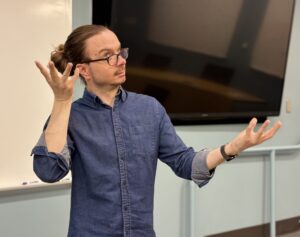
Wink, PhD, NIC-Master, is an interpreter, educator, and researcher with over sixteen years of professional instruction and research in the field of interpretation. He has presented at national conferences, including the National Association of the Deaf (NAD) and the Registry of Interpreters for the Deaf (RID), and across the United States and Canada. His focus is on the intersection of skill development, practice, and theory in interpretation, highlighted by his workshops and a published article on deliberate practice in the Winter 2012 issue of RID Views. He has also served on the Certification Council for RID, held a board position with the Conference of Interpreter Trainers (CIT), and received the NAD Outstanding Service to Interpreting Award in 2016. As of 2023, Wink has delivered over 2,800 hours of live CEU professional development training.
Currently serving as an assistant professor in the Department of Interpretation and Translation at Gallaudet University, Wink engages with undergraduate and graduate students, fostering a deeper understanding of interpretation and encouraging graduate students to become change agents in the field. His doctoral work explores the embodied motivations of imagery in depiction and the processes through which they are constructed. His academic work centering on interpreting and translation, focuses on message analysis within a cognitive linguistic framework and the role of depiction in interpretation. His approach redefines traditional notions of expansion and equivalence, offering a more nuanced perspective, while his exploration of depiction provides interpreters with a structured framework for effectively conveying meaning.
With nineteen years of professional interpreting and translation experience, Wink has developed translated tours for the U.S. Capitol and the Sixth Floor Museum in Dallas. Outside of academics and interpreting, Wink enjoys crafting ASL stories on and off the stage for his cat’s amusement.
Request a Workshop
Request this WorkshopRegister
Contact Us!
Questions or Concerns?Organizer

ASL Interpreting Servicesinfo@aslis.com 5801 Duluth Street, Suite 106, Golden Valley, MN 55422